
Visual Inspection of Color and Texture
Natural Color Variations and Depth
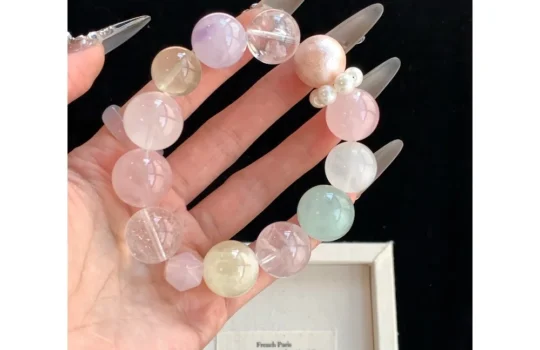
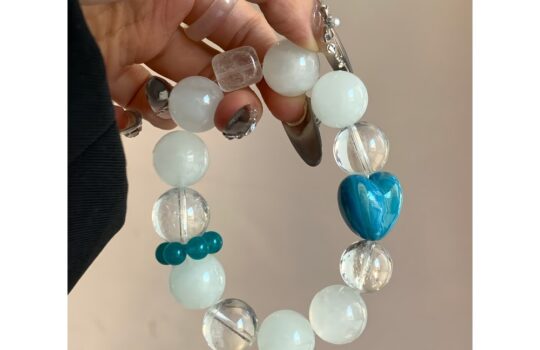
Genuine green phantom quartz (commonly known as “green幽灵” in Chinese contexts) displays a range of green hues, from light mint to deep forest green. The color distribution is rarely uniform; instead, it often features subtle gradients or patches of varying intensity. This unevenness arises from natural mineral inclusions forming during crystallization. In contrast, synthetic or dyed stones may exhibit overly vibrant, artificial colors with no visible transitions or depth. For example, a bracelet with beads that are uniformly bright green without any lighter or darker areas is likely fake.
Texture and Surface Imperfections
Authentic green phantom quartz has a natural, slightly rough texture due to internal inclusions and growth patterns. When examined closely, you may notice tiny cracks, cloudy patches, or mineral streaks within the beads. These imperfections are proof of the stone’s organic formation process. Synthetic alternatives, however, tend to have a flawless, glass-like surface with no visible flaws. Run your fingers along the beads—genuine stones will feel tactile and uneven, while fakes may feel perfectly smooth.
Internal Inclusions and Optical Properties
Unique Inclusion Patterns
The defining feature of green phantom quartz is its internal inclusions, which often resemble landscapes, pyramids, or cloud-like formations. These inclusions are created by trapped minerals like chlorite or hematite during the crystal’s growth. Use a magnifying glass to inspect the beads for these natural patterns. Authentic stones will have irregular, asymmetrical inclusions that appear three-dimensional. Synthetic stones, on the other hand, may have artificial inclusions that look flat, repetitive, or overly perfect. For instance, inclusions shaped like perfect geometric triangles or circles are a red flag.
Transparency and Light Refraction
Genuine green phantom quartz has a translucent to opaque appearance, depending on the density of inclusions. When held up to light, natural stones allow light to pass through in a diffused manner, creating a soft glow. High-quality pieces may also display a phenomenon called “double refraction,” where light splits into two rays, causing a doubled image when viewed through the stone. To test this, place a bead on a printed line—if the line appears doubled, the stone is likely real. Synthetic materials, like glass or plastic, will not exhibit this property.
Physical Tests for Authenticity
Hardness and Scratch Resistance
Green phantom quartz ranks 7 on the Mohs scale of hardness, making it resistant to scratches from most materials except harder minerals like topaz or diamond. To test this, gently scratch the surface of a bead with a steel nail or a piece of quartz. A genuine stone will resist scratching, while softer materials like glass or plastic may show marks. However, avoid testing delicate or polished stones, as this could damage them. Instead, focus on rough-edged beads or areas with natural imperfections.
Thermal Conductivity and Weight
Natural green phantom quartz feels cool to the touch initially and warms up slowly when worn, as it absorbs and retains heat differently from synthetic materials. Synthetic stones, like glass or resin, may feel warm immediately or heat up quickly. Additionally, genuine stones are denser than fakes, so they will feel heavier for their size. Compare the weight of the bracelet to a similar-sized object made of glass or plastic—if the bracelet feels noticeably heavier, it is likely authentic.
Sound and Vibration Test
Gently tap two beads together or against a hard surface and listen to the sound they produce. Genuine green phantom quartz, being a dense crystalline material, will produce a clear, ringing sound similar to a gentle chime. Synthetic or hollow imitations may sound dull, hollow, or plastic-like, as they lack the density and structural integrity of natural stone. This test is best used in combination with other methods for more accurate results.